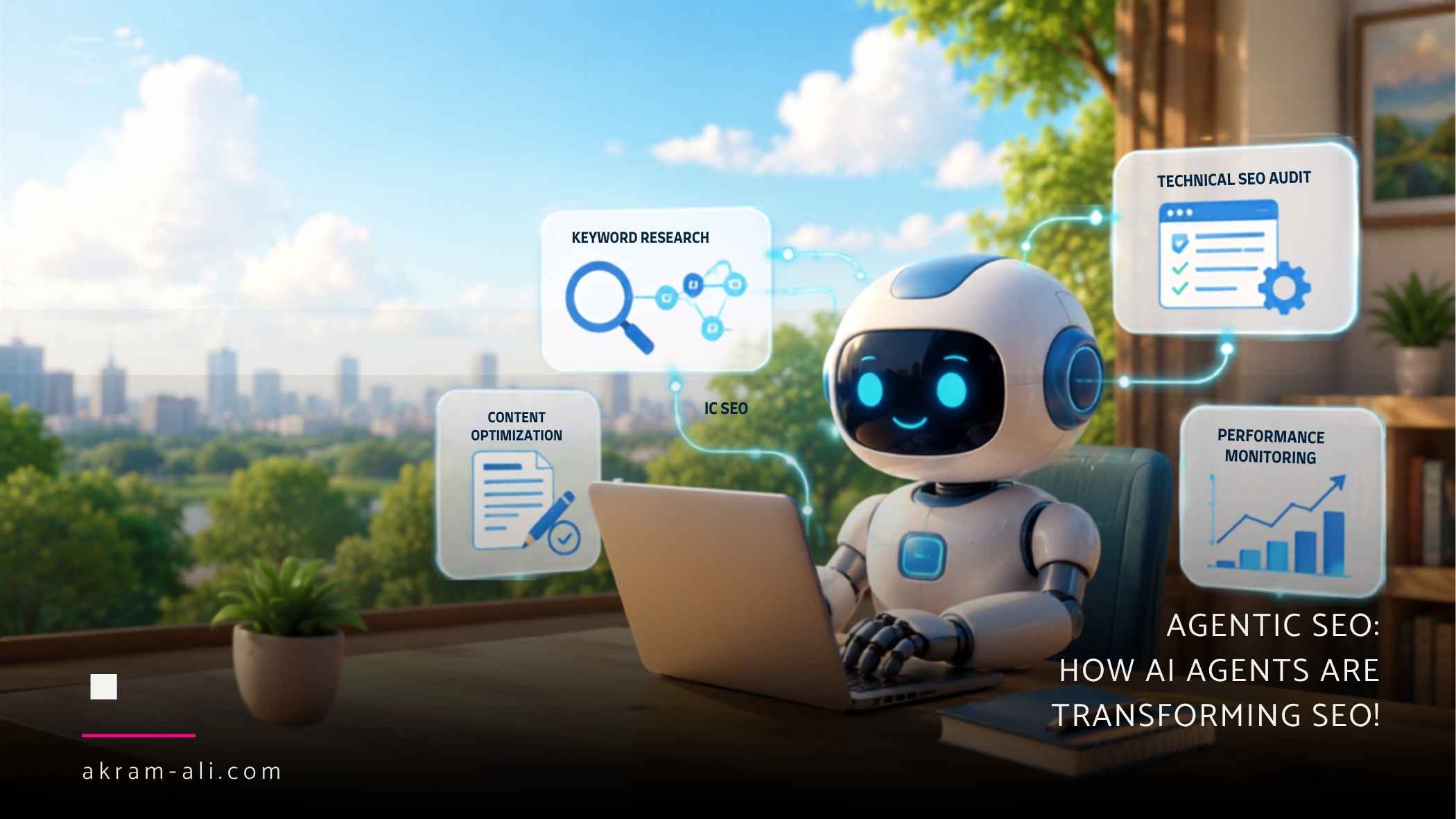
Agentic SEO is an approach to search engine optimization that uses autonomous AI agents to research, plan, execute, and monitor SEO tasks with minimal human intervention!
Search engine optimization has changed significantly throughout my 16+ years of working in digital marketing, consulting with businesses, and training marketing professionals. SEO professionals have moved from manually checking rankings and spreadsheets to using sophisticated platforms for keyword research, technical audits, content analysis, and performance measurement.
Artificial intelligence is now creating another major shift. Marketers are progressing from using AI for isolated activities, such as writing a meta description, to using AI agents that can plan and coordinate multiple SEO tasks.
This development is called Agentic SEO.
Instead of waiting for a marketer to provide a separate prompt for every activity, an AI agent can receive an objective, create a plan, access connected SEO tools, analyse data, recommend actions and monitor results.
Based on my experience in digital marketing strategy, analytics and AI education, I see Agentic SEO as a change in how SEO work is performed. It does not replace SEO strategy or human expertise. It introduces a more autonomous method of executing and managing interconnected SEO activities.
What Is Agentic SEO?
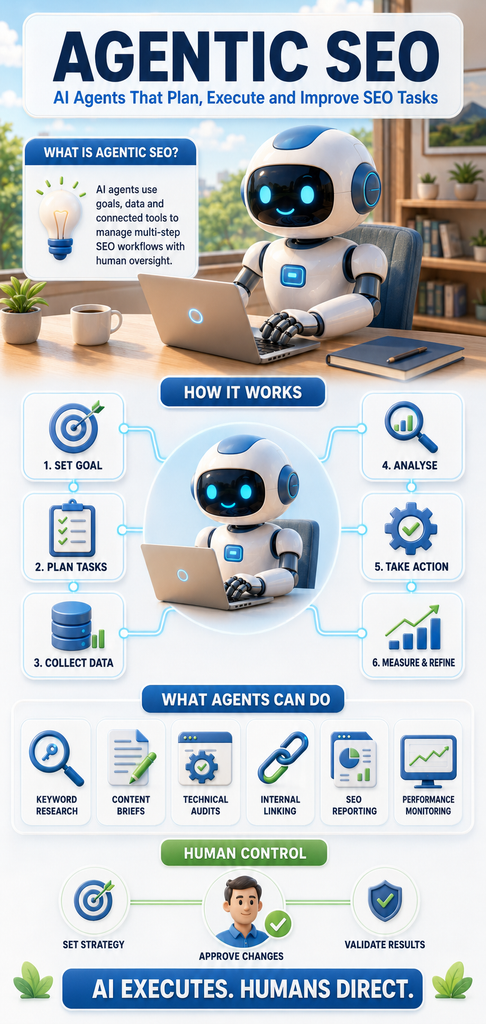
Agentic SEO is the use of autonomous or semi-autonomous AI agents to plan, perform, monitor and refine search engine optimization tasks.
An AI agent is more than a generative AI tool. IBM defines an AI agent as a system that autonomously performs tasks by creating workflows and using available tools. AI agents can plan subtasks, access external data, make decisions and modify their actions as new information becomes available. IBM: What Are AI Agents?
In an SEO context, an agent might:
- Receive an objective, such as identifying pages losing organic traffic.
- Retrieve performance data from Google Search Console.
- Compare current and historical results.
- Inspect the affected pages.
- Identify possible technical or content-related causes.
- Prioritize pages based on traffic or conversion potential.
- Prepare recommendations.
- Monitor performance after approved changes.
The agent performs an interconnected Agentic SEO workflow, rather than completing one isolated task.
What Is the Difference Between Generative AI and Agentic SEO?
Generative AI creates an output in response to a prompt. For example, a marketer might ask an AI tool to suggest ten blog titles or write a meta description.
The tool normally stops after producing the requested output.
Agentic AI SEO goes further. An AI agent can decide which steps are required, select the appropriate tools, gather information, assess findings and determine what to do next.
| Generative AI for SEO | Agentic SEO |
|---|---|
| Responds to an individual prompt | Works towards a broader objective |
| Produces one output | Coordinates multiple tasks |
| Depends on repeated instructions | Plans the next steps |
| May rely mainly on prompt context | Uses connected platforms and data |
| Stops after generating an answer | Measures results and continues the workflow |
| Acts as an assistant | Acts as a controlled operational agent |
For example, generative AI might write a content brief for a keyword. An Agentic SEO agent could identify the keyword opportunity, analyze existing content, examine search intent, prepare the brief, recommend internal links, and schedule a future performance review.
How Does an Agentic SEO Workflow Operate?
A practical Agentic SEO workflow usually includes a language model, defined instructions, connected data sources, SEO tools, permissions and human-review checkpoints.
1. Goal Definition
A human begins by defining the desired outcome.
Examples include:
- Find pages with declining organic performance.
- Identify content gaps within a topic cluster.
- Prioritize technical SEO issues.
- Improve internal linking.
- Prepare monthly SEO reports.
- Find keywords with strong conversion potential.
The goal needs to be specific. “Improve my SEO” gives the agent little strategic direction.
A stronger goal would be:
Identify existing service pages that have lost non-branded organic clicks during the past three months and recommend updates based on search-query and conversion data.
2. Planning and Task Decomposition
The agent divides the goal into smaller tasks.
For the declining-pages example, the agent might:
- Retrieve landing-page data.
- Compare two periods.
- Filter branded queries.
- identify pages with meaningful declines.
- Review changes in impressions, clicks and positions.
- Check for technical problems.
- Analyze content coverage.
- Prioritize pages according to business value.
This planning capability separates Agentic SEO from fixed automation.
3. Data and Tool Access
An AI agent becomes useful when it can work with reliable business and SEO data. Depending on its permissions, it may connect with:
- Google Search Console
- Google Analytics 4
- Keyword research platforms
- Website crawlers
- Rank-tracking software
- Page-performance tools
- Content management systems
- Project management platforms
- Internal sales or conversion data
Google’s Analytics Data API, for example, allows programmatic access to Analytics reporting data. It can support automated reports, custom dashboards and integrations with other business applications. Google Analytics Data API
Access to tools does not automatically produce a sound recommendation. The agent must receive accurate definitions, such as what the business considers a conversion, qualified lead or priority page.
4. Analysis and Reasoning
The agent analyses the collected information and considers possible explanations.
A decline in clicks could result from:
- Lower search demand
- Lost rankings
- Reduced click-through rate
- Changes in the search results
- Indexing problems
- Content becoming outdated
- A competing page gaining relevance
- Keyword cannibalization
- Website or tracking changes
A useful agent should not immediately assume that every traffic decline requires rewriting the page. It should compare several signals and explain the reasoning behind its recommendation.
5. Action or Recommendation
The agent may recommend an action or prepare it for approval.
Possible outputs include:
- Keyword clusters
- Content briefs
- Revised title tags
- Internal-link recommendations
- Technical SEO tickets
- Content-refresh suggestions
- Redirect maps
- Monthly performance reports
Low-risk tasks can receive a higher level of automation. Changes affecting indexation, canonicalization, redirects, publishing, or page deletion should require human review.
6. Measurement and Refinement
After an approved action, the agent monitors relevant metrics and compares the results with the original objective.
The complete process becomes:
Goal → Plan → Collect Data → Analyse → Recommend → Approve → Measure → Refine
What SEO Tasks Can AI Agents Perform?
Keyword Research and Clustering
AI agents for SEO can collect keyword data, remove duplicates, group semantically related terms and classify keywords by search intent.
An agent can also connect keyword opportunities with existing pages. This helps the SEO professional decide if the business needs a new page or an update to an existing one.
Human judgment remains important. High search volume does not automatically make a keyword relevant or commercially valuable.
Content Gap Analysis
An agent can map the website’s existing content, compare it with selected competitors and identify missing topics.
A stronger agent will also consider:
- Audience relevance
- Existing topical authority
- Search intent
- Funnel stage
- Product or service connection
- Conversion potential
- Content overlap
This prevents a business from creating pages merely because competitors have published them.
AI agents can also identify relationships between pillar pages and supporting content, making it easier to organize related keywords and recommend contextual internal links. Learn how to structure this approach through my detailed guide to the topic cluster framework.
Content Brief Creation
An Agentic SEO agent can use approved keyword and competitor data to prepare a structured content brief.
The brief may include:
- Primary and secondary keywords
- Search intent
- Recommended headings
- Common questions
- Relevant internal links
- Supporting sources
- Content gaps
- Conversion objective
AI-generated briefs still need editorial review. Google advises website owners using generative AI to focus on accuracy, quality, and relevance. Producing many low-value pages through automation may violate its scaled-content abuse policies. Google’s guidance on generative AI content
AI agents can accelerate SEO analysis, but marketers still need a strong understanding of on-page optimization to evaluate their recommendations. My On-Page SEO Mastery Guide provides a step-by-step framework and editable templates for keyword research, SEO audits, content optimization, strategy and reporting.
Technical SEO Audits
Agentic SEO tools can help process crawl data and prioritize issues such as:
- Broken internal links
- Redirect chains
- Missing canonical tags
- Duplicate titles
- Orphan pages
- Slow-loading templates
- Indexability conflicts
- Sitemap inconsistencies
- Structured data errors
The main benefit is prioritization. A standard crawler may report thousands of issues. An agent can group related problems, estimate their impact and identify the templates or sections responsible.
Internal Linking
An agent can examine page topics, existing links and target keywords before recommending contextual internal links.
It can identify:
- Orphan pages
- Pages with too few internal links
- Relevant source pages
- Suitable anchor-text variations
- Topic-cluster relationships
Automatically inserting links without review can produce irrelevant anchors or poor user experiences. Recommendations should be checked before publication.
SEO Reporting and Monitoring
AI agents can collect data, detect unusual changes and prepare summaries tailored to different stakeholders.
A monthly Agentic SEO report could explain:
- What changed
- Which pages were affected
- What may have caused the change
- Which actions were completed
- What should happen next
- How SEO contributed to conversions
This is more useful than exporting tables without interpretation.
My Five-Part Agentic SEO Framework
Based on my work in digital marketing, analytics and AI training, I recommend evaluating every Agentic SEO workflow through five components.
Objective
Give the agent a specific business and SEO outcome. Avoid broad instructions without measurement criteria.
Evidence
Provide reliable data from approved sources. Recommendations based on incomplete or outdated information should be flagged.
Reasoning
Require the agent to explain how the evidence supports its conclusion. A recommendation should contain a rationale, not merely an instruction.
Controlled Action
Define which actions the agent can perform independently and which require approval.
Measurement
Select metrics before execution. These might include impressions, clicks, qualified sessions, leads, conversions, revenue or issue-resolution time.
In my view, these five components separate a meaningful agentic system from a chatbot placed on top of an SEO dashboard.
Benefits of Using AI Agents for SEO
Faster Analysis
Agents can process large keyword lists, crawling reports and performance datasets faster than manual analysis.
Continuous Monitoring
An agent can monitor websites and alert the team when it detects meaningful changes in traffic, rankings, indexation or technical health.
Better Prioritization
Instead of presenting a long list of issues, an agent can classify them by likely impact, business importance and implementation effort.
More Consistent Processes
Defined agent workflows can apply the same audit criteria across pages, websites and reporting periods.
Better Use of Human Expertise
SEO professionals can spend less time preparing spreadsheets and more time on strategy, brand positioning, audience understanding and decision-making.
Risks and Limitations of Agentic SEO
Agentic SEO also introduces meaningful risks:
- Incorrect interpretation of data
- Hallucinated recommendations
- Outdated information
- Weak understanding of business context
- Harmful technical changes
- Generic or duplicated content
- Excessive keyword optimization
- Unauthorized access to sensitive data
- Actions without an adequate audit trail
An agent may identify correlation without understanding causation. For example, it may connect a content update with improved rankings even when seasonality or an algorithm change influenced the result.
The safest approach is controlled autonomy. Give agents greater freedom for data collection, classification and monitoring. Apply stronger human controls to publishing, technical implementation and strategic decisions.
How to Start Using Agentic SEO
Begin with one narrow and measurable use case.
A practical starting process is:
- Select a repetitive SEO task.
- Define the expected output.
- Identify the approved data sources.
- Establish rules and permission limits.
- Add human-review checkpoints.
- Test the agent on historical data.
- Compare its output with expert analysis.
- Monitor errors and refine instructions.
- Expand the workflow only after consistent results.
Monthly reporting, content-decay detection, and keyword classification are generally safer starting points than automatic publishing or technical website changes.
Frequently Asked Questions About Agentic SEO
Is Agentic SEO the Same as AI SEO?
No. AI SEO is a broad term covering almost any use of artificial intelligence in SEO. Agentic SEO specifically involves AI agents that can plan and coordinate multiple tasks around a defined objective.
Will AI Agents Replace SEO Professionals?
AI agents are more likely to change how SEO professionals work. Agents can reduce repetitive analysis and reporting, but humans still provide strategy, customer understanding, creative judgment and accountability.
Can an AI Agent Publish SEO Content Automatically?
Technically, an agent can publish content when connected to a content management system. However, automatic publication creates quality, accuracy and brand risks. Human editorial approval is advisable.
What Are the Best Agentic SEO Tools?
The category is still developing. An Agentic SEO tool should be assessed according to its integrations, data access, reasoning transparency, permission controls, security, activity logs and human-review features.
A strong setup may combine an AI agent platform with Search Console, GA4, a website crawler, keyword data and a project management system.
Can Small Businesses Use Agentic SEO?
Yes. Small businesses can begin with focused workflows such as monthly reporting, technical issue monitoring, keyword grouping or identifying pages that require updates.
Does Agentic SEO Guarantee Higher Rankings?
No. AI agents can improve the speed and consistency of SEO work, but they cannot guarantee rankings. Search performance still depends on relevance, competition, content quality, technical health, authority and many external factors.
Final Perspective on Agentic SEO
Having worked across digital marketing strategy, SEO, analytics and AI education, I see Agentic SEO as an operational advancement rather than a replacement for SEO fundamentals.
Its main value lies in connecting tasks that SEO teams currently perform separately. An agent can collect data, analyse patterns, prepare recommendations and monitor outcomes within one structured workflow.
The strongest model combines:
- Human strategy to define audiences, priorities and business objectives.
- AI agent execution to coordinate repeatable analysis and operational tasks.
- Human validation to review accuracy, context and potential impact.
Businesses should start with controlled, measurable workflows and expand autonomy gradually. The goal is not to remove people from SEO. It is to help SEO professionals work faster, apply their expertise more effectively and make better-supported decisions.
About the Author
Akram Ali is a digital marketing and AI consultant, trainer, educator, author, and keynote speaker with more than 16 years of professional experience. He has trained and mentored over 40,000 learners across 15+ countries and has worked with professionals, business schools, and organizations on digital marketing, SEO, analytics, branding, and AI-led marketing strategy.
He is the author of the Amazon bestselling book Finding Your Niche as a Freelancer: A Step-by-Step Workbook and has been recognized as one of the Top 1% of Digital Marketers on Topmate.